
Franchisor Must Do’s for Success
At Kingside Partners, we see too many high-potential franchisors stall because they don’t balance growth ambition with the systems, the unit economics, and the support structures required for scale, sustainability and a successful exit. The winners are those who build scalability into their DNA.
Throughout my career I have worked with a variety of highly successful B2C multi-unit businesses across various industries and sizes ranging from quick service/fast casual restaurants to specialty retailers to fitness chains to home service providers to health care providers. These businesses were in some instances privately held company- owned bricks & mortar businesses as well as high profile public and private equity backed franchisors and franchisees.
I have also worked with both early-stage franchisors and franchisees – the latter who bought into the appeal of owning a franchise as a formula of “ build out and they will come” while the former enamored with leveraging a franchisee’s investment capital fueling expansion and franchisor enterprise value. In these instances, the learnings were such that is not so simple and that there are an interdependency of a franchisor and the franchisee that is inescapable.
While a B2C franchise business model and a company owned B2C multi-unit business share similar operating goals such as (i) driving unit expansion (ii) delivering a high-quality service/product (iii) creating a trusted brand and (iv) achieving a successful exit , there are very significant differences as to how such is to be accomplished. The implications for a nascent franchisor are extensive and consequential.
Differences in legal structure, ownership & operating rights, degree of investment capital deployed and the risk/reward calculus must be fully understood and truly appreciated for a franchisor to avoid the litigation minefield that often plagues the franchisee industry. Disgruntled and disappointed franchisees can be a recipe for litigation. Selecting the right franchisee is key. Simply buying a franchisee is not a replacement for requisite acumen, fortitude and staying power including the requisite capital that running a business requires. Franchising can be an effective way to expand and achieve success but it also brings with it inescapable factors that a franchisor must focus on. This blog lays out some of those key factors.
Scaling Smarter: What High-Potential Franchisors Must Do to Drive Sustainable Growth and How we help
Franchising is one of the fastest ways to scale a business model. But moving from a handful of units to a strong regional or national footprint isn’t about simply selling more licenses- it’s about building the right foundation to ensure both franchisor and franchisees succeed.
At Kingside, we apply rigorous corporate finance tools that serve as an integral management tool with the disciplines of marketing and customer service—valuation modeling, sensitivity analysis, and performance dashboards—to help franchisors prove and refine their unit economics.
Our marketing strategists develop marketing plans for franchisors and manuals for franchisees to enhance their marketing acumen, deliver revenue building ideas, convey the marketing funnel that starts with awareness leading to customer interest and intent and then customer acquisition for the follow n loyalty and advocacy. Our digital marketing team build websites that engage and convert, manages SEM, social campaigns, and lead conversion funnels, ensuring franchisees aren’t left to figure it out themselves.
Our team develops and manages multi-channel acquisition strategies that reduce dependency on any single platform, create more predictable lead flow, and maximize ROI for both franchisor and franchisee marketing spend.
Kingside’s corporate finance expertise—shaped by decades in private equity, venture capital, and IPOs—helps franchisors structure capital plans and manage available capital and/or potential third-party capital that doesn’t dilute founders excessively or too early or over-leverage too quickly.
We help franchisors design KPI dashboards and performance improvement frameworks that keep franchisees accountable while giving them the tools to succeed.
Kingside integrates brand strategy with operational execution, ensuring the brand grows stronger—not diluted—with every new unit. Franchising is about more than selling licenses. It’s about building a system that seeks to make every franchisee successful—and by doing so, creates enterprise value for the franchisor. The Key factors for Franchisors to focus on are as follows:
1. Build Unit Economics That Actually Work
Franchise success begins at the unit level. If franchisees can’t achieve consistent, attractive returns, scaling is impossible. High-potential franchisors must:
– Driving “Four wall EBITDA” and the corporate finance principles of net available free cash flow, IRR, return on invested capital (ROIC) and other capital finance measurements
– Validate unit-level profitability across diverse markets.
– Create realistic financial models that account for labor, occupancy, marketing, and seasonality.
– Continuously monitor and benchmark results against the pro forma.
2. Create Marketing Systems That Drive Demand
A strong franchise concept fails without customers walking through the door. Sustainable growth requires:
– A proven marketing strategy that is not just advertising and referral development but also includes a digital and social media marketing playbook that franchisees can plug into.
– Data-driven campaigns that deliver measurable quality leads, not just Facebook impressions.
– Scalable brand-building that balances national consistency with local customization.
3. Balance Growth Capital with Responsible Expansion
Franchisors often underestimate the capital required to support growth—technology platforms, field staff, training systems, and national marketing. Overextension is a common pitfall.
– Secure the right mix of growth capital (equity, debt, or hybrid).
– Align funding strategy with the franchise’s stage of maturity.
– Build a roadmap that balances new-unit growth with operational excellence.
4. Develop Franchisee Support Systems
Franchisees aren’t just customers of the brand—they are partners whose success determines your success. High-potential franchisors must:
– Provide onboarding and training that truly prepare operators.
– Offer ongoing coaching and performance improvement support.
– Create transparent, data-based communication that builds trust.
5. Protect and Enhance Brand Value
As you scale, maintaining quality control and brand standards becomes harder. Yet brand value is the franchisor’s most important asset.
– Enforce operating procedures without alienating entrepreneurs.
– Invest in design, creative, and customer experience.
– Stay ahead of competitors through continuous innovation.
6. Build a Multi-Channel Customer Acquisition Strategy
Scaling isn’t just about opening more units—it’s about ensuring that each location has a steady, reliable flow of customers. In today’s competitive environment, relying on a single marketing channel is too risky and leaves franchisees vulnerable to shifts in consumer behavior or digital platform policies. Successful franchisors must:
– Diversify acquisition channels across paid digital ads, social media, search, referral programs, and partnerships.
– Balance national campaigns with local store marketing initiatives that drive community engagement.
– Implement measurement frameworks that track cost per lead, conversion rates, and customer lifetime value across channels.
In Summary –
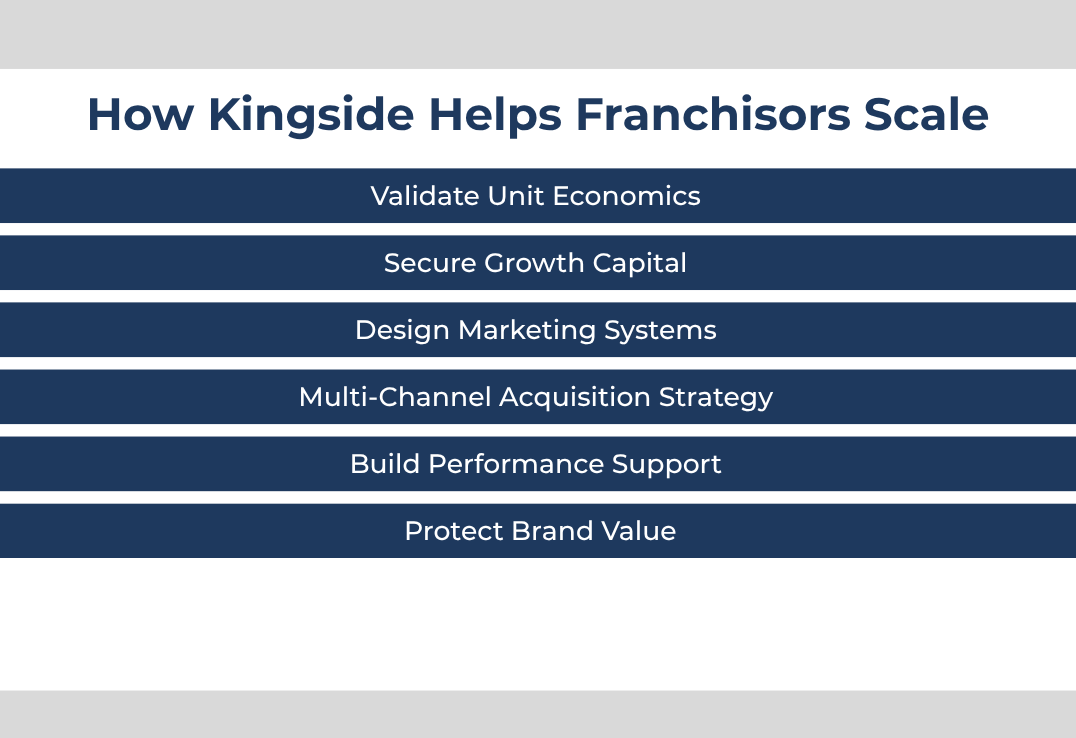
We’re more than advisors—we operate as an integrated finance and marketing partner for high-potential franchisors. Our role is to help founders and management teams:
– Validate and optimize unit economics with financial rigor.
– Secure and structure growth capital with private equity and capital markets expertise.
– Design and execute scalable marketing systems that deliver franchisee results.
– Build performance improvement frameworks that sustain long-term growth.