
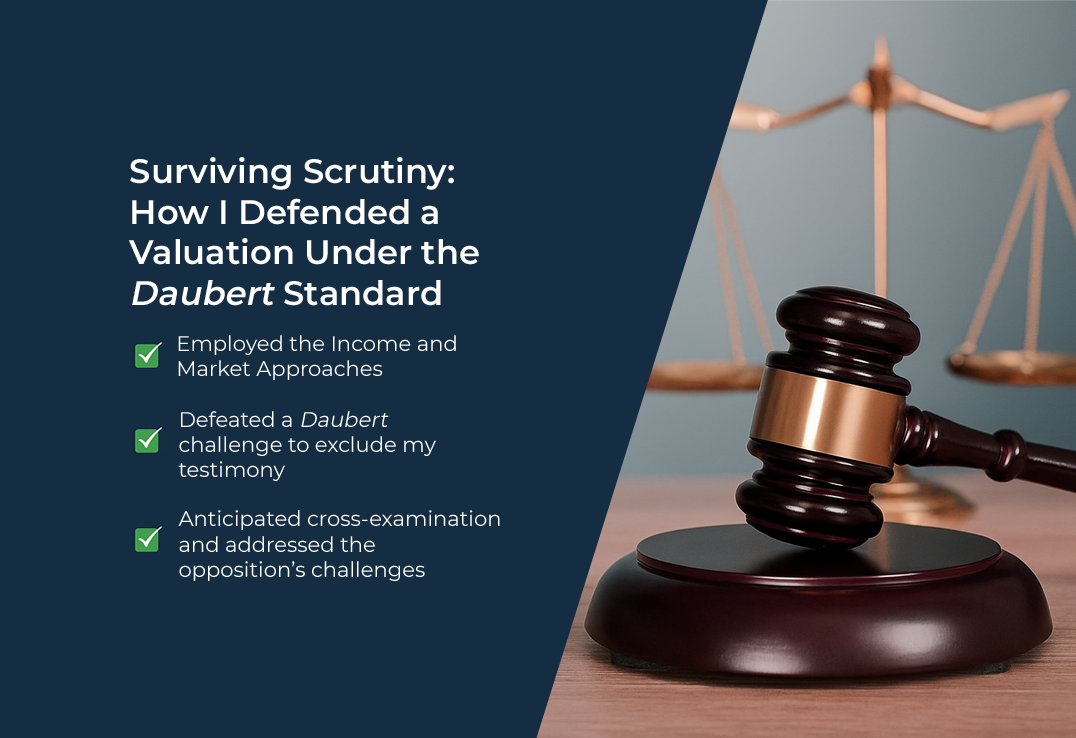
Surviving Scrutiny: How I Defended a Valuation Under the Daubert Standard and Cross-Examination – Professionalism and Credibility
In our scope of services to clients, Kingside Partners provides litigation support and related valuation services. Valuation is also an integral part of fund-raising support services.
In the area of litigation support , we deliver corporate finance expert testimony, particularly for multi-unit, consumer centric and marketing centric businesses.
After the public accounting phase of my early career with audit clients primarily in the B2C space, I served for over a decade as a C-suite financial and operating executive helping to build organically and through acquisitions the largest regional Pizza chain in New England (over 200 units). I then led the sale of the business to top tier private equity firms. Later throughout the balance of my career as a public company executive, a NASDAQ board member, a co-founder in a startup backed by top-tier venture capital firms and HNW investors , an advisor to early stage technology companies and today, as a service business owner, my business focus has consistently had me dealing with the various facets of corporate finance and the “deal world”- capital raises, bank financings, acquisitions, divestitures and valuations.
Litigation support engagements and the associated valuation work carry unique considerations. There is likely a protagonist waiting on the other side of our deliverables. When you serve as a business valuation expert in litigation support, it’s not enough to “know the numbers” or apply “core and advanced valuation techniques.” You must also prepare for your work to be picked apart by opposing counsel, likely to be challenged under the rigorous standards of Daubert v. Merrell Dow Pharmaceuticals, Inc., a legal framework that governs the admissibility of expert testimony in both federal and state courts.
In one recent case we prepared and submitted a damages opinion for our multi-unit restaurant client that not surprisingly was challenged by the opposing attorney. A “MOTION IN LIMINE” was filed by the opposing attorney seeking to have the court dismiss our work and bar our damages opinion. The court swiftly rejected the filing, denying the motion for reasons that were obvious and truly inarguable as the judge in his ruling made it quite clear that our status as recognized experts and work met the requisite standards :
(a) scientific, technical, and of other specialized knowledge helping the trier of fact to understand the evidence or to determine a fact in issue;” and
(b) “the testimony was based on sufficient facts or data;” and
(c) “the testimony was the product of reliable principles and methods;” and
(d) “we applied the principles and methods to the facts of the case.”
In another recent case in New Hampshire, I was retained to provide an expert valuation of a closely held B2C business in the hospitality space that was mired in a lengthy, protracted contested legal dispute . The case not only once again served to call on my technical skills and experience, but also once again came to reaffirm that a well-prepared, transparent, and standards-based valuation will survive even the most aggressive courtroom scrutiny.
It is all about Professionalism and Credibility.
Laying the Foundation: Valuation Methods That Meet Daubert
The scope of services was to determine the fair market value of the privately held B2C operating business as of a specified date. The subject company ( majority owned and operated by the opposing side) failed to provide complete financial statements or projections, which meant we had to rely on historical tax returns and independently construct a set of forward-looking projections. I advised our client’s counsel, a premier national law firm, that we would proceed as engaged but to be fully appreciative of the potential limitations and the challenges that almost assuredly lay ahead in the cross examination despite the fact that such lack of information was caused by their failure to cooperate.
Using Long Established & Accepted methodologies of Corporate Finance.
Rather than rely on a single approach, we applied multiple generally accepted valuation methodologies:
– The Income Approach, using the Discounted Cash Flow (DCF) method with five projection scenarios.
– The Market Approach, applying revenue and EBITDA multiples based on and sourced from comparable, authoritative private company transaction data, local market data and our independent research,
– The Asset Cost Approach was also applied employing cost build out data and related costs derived from widely recognized construction industry third party sources.
Throughout the process, we adhered to guidance from the AICPA’s Statement on Standards for Valuation Services (SSVS No. 1) and the Uniform Standards of Professional Appraisal Practice (USPAP)—both of which stress the importance of transparency, professional judgment, and data reliability.
Daubert Challenge: Motion to Exclude – using AI for more muscle
Shortly before the hearing, opposing counsel filed a motion to challenge our work and my expert standing, arguing that the projections were speculative and that the absence of management-prepared forecasts served to discredit my analysis.
I was ready.
With support from OpenAI’s GPT-4o (yes, I use AI when it adds value which is quite often in a variety of matters – contracts, advisory, source gathering, thought partnership), I had prepared a detailed written and verbal response to the many anticipated objections and cross examination attacks. My response among other things emphasized:
– My acceptable reliance on reasonably relied upon data under Rule 702.
– The accepted industry practice of using tax returns and analyst-constructed projections when management data is unavailable supported by credible authoritative sources,
– The use of multiple valuation methods and scenario analysis as a strength, not a flaw.
-The three different valuation methodologies buttressing the valuation range.
The court denied the opposing counsel’s motion to exclude. I was reaffirmed as a valuation expert, and our report was admitted. In conclusion, my client’s interests prevailed in large part to the exhaustive approach taken by Kingside Partners.
It is all about Professionalism and Credibility.
Cross-Examination: Anticipated and Neutralized
During cross-examination, opposing counsel attempted to undermine my conclusions by:
-Questioning the independence of my assumptions
-Highlighting the absence of management forecasts
-Suggesting that the proffered valuation range was too wide to be credible
-Provoking emotional reactions and causing confusion – “getting back on my heels”
Thanks to detailed preparation and the inherent confidence that comes from decades of real world experience, I met under oath each line of questioning head-on:
– I explained that the absence of internal data was transparently disclosed and offset by conservative scenario modeling.
– I cited multiple professional valuation standards that support ranges when uncertainty exists.
– I made clear that my role was not to advocate, but to inform the court with a reasoned and supportable opinion grounded in accepted practice.
Result: A Valuation Work Product That Stood the Test
The court accepted and endorsed my valuation testimony in full. I was told after the proceedings that the judge had excoriated the opposing side for their failures and behavior. My client greatly appreciated the clarity and professionalism of our work and I walked away with further confirmation that professionalism, credibility grounded in experience, strong methodology, full transparency, and proactive preparation, including anticipating Daubert-style challenges—are what separates a defensible expert opinion from one that falls apart under pressure.
It is all about Professionalism and Credibility.
Takeaway for Legal Professionals- Working with Kingside Partners –
If you’re litigating a matter where business value is at issue, don’t wait for valuation problems to surface under fire. Engage an experienced, battle tested expert who:
- Has the real-world corporate finance knowledge and experience
- Possesses the required business sophistication and acumen
- Can Navigate imperfect situational factors such as incomplete records
- Can build and apply multiple, defensible methodologies and techniques
- Can produce well written opinions and conclusions that meet the standards of both court fact finders, financial professionals and legal decision-makers
- And most importantly—can stand up under cross-examination and take body blows from protagonists
We welcome discussions to see how we may be helpful. Feel free to reach out
nmammola@kingsidepartners.com if you’d like to talk through a case or explore how our valuation work can help support your litigation goals.